In the morning it was so misty that I could barely see from one end of Copacabana to the other. That's it then, time to go, no Corcovado. I ate a leisurely breakfast and then asked the doorman to hail me a taxi. He asked me if I would be interested in his mate's car, but I said no I want a real taxi. He misheard that as yellow taxi, but it had the same result as that's the colour of Rio taxis. At the bus station it took me a while to locate the right company, so numerous were the destinations. There were metal detectors at departure gates. Made me wonder why they had instituted that check.
I tried to get a glimpse of Cristo Redentor on the way out, but it was not visible. So I left Rio unredeemed. This was the first time I was seeing rural Brazil in daylight, I realised. The lush tropical vegetation reminded me of Malaysia. Highway 101 was lined with billboard advertising. Roadside vendors sold biscuits, canned drinks, fresh coconuts and oranges (R3 a sack). We passed housing estates which looked basic but serviceable. But what great access to the beach and what views! Nowhere in Brazil is there such intimacy between land and sea, wrote Rubem Braga of the Costa Verde (Green Coast), the littoral I was travelling through.
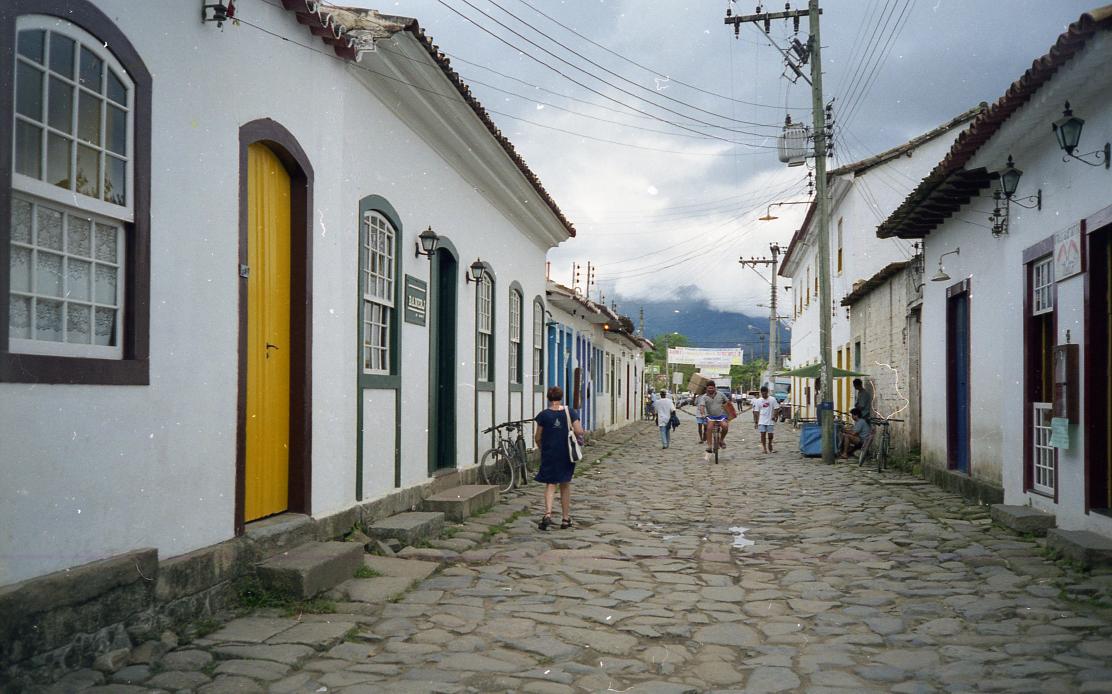
At Paraty, the Pouso Familiar Helicônia was very close to the bus station. But Paraty (sometimes spelled Parati) is small enough that everywhere is walking distance anyway. I got a warm welcome and directions to a nearby por quilo restaurant. The old town has some of the best preserved colonial architecture in Brazil, including concave cobblestone streets. In the picture you see the boundary of the old town at the end of the street.
Paraty's heyday was when it was one end of the gold trail from Minas Gerais (General Mines). Eventually the route switched to Rio to avoid raids from pirates who infested the islands and coves of the bay of Angra dos Reis. So in fact the lovely convoluted coastline was a factor in Paraty's decline. Eventually the gold ran out and that sealed Paraty's fate as a backwater.
This is the Capella de Santa Rita. The crowd by the side are spectators of a telenovela or film shoot. The wealth of old buildings in Paraty makes it a favoured spot for filming period dramas.
I looked around another pousada and bar halfway up a hill, one that was out of my price range, but that I had read a web review of, with pictures. One of the earliest travel blogs on the net if you like. It was just as pretty as the photos. I gave a printout of the review to the owner, in case he hadn't seen it online.
Back at the hostel I noticed mosquitoes in the room. As expected of the tropics and as expected the owner gave me a mosquito coil. The shower was the instantaneous type with wires running to the heater inside the shower head. It looked lethal. I was to see this type of water heater often in South America.
In the evening I went to the Arpoador Restaurant in the historical centre. There I had lula baiana (squid Bahian style), probably a moqueca. It was fantastic. There was an unexpected extra cover charge for a jazz pianist who came on later, but he was worth it too. He wasn't your usual cocktail jazz pianist. He set up an infectious rhythm with the left hand to accompany.
It was dark and drizzling when I left. Night falls rapidly in the tropics. An island of light at a local joint betrayed where a group of townsfolk were watching football on a big TV. It is their national obsession.
Last day in Rio and it looks like I'm not going to make it to Corcovado with this mist. There might be an outside chance tomorrow morning. I surveyed the half day tours on offer in the lobby of the Rio Othon hotel and signed up for Pão de Açúcar (Sugarloaf) in the afternoon. I rang the bus station and was assured that there were plenty of seats to Paraty the next day. The lobby also had a cased display of minerals. Brazil produces 90% of the world's gemstones, thus the origin of my parrot trinket.
Cars exhaust fumes around here have a fruity smell due to the use of alcohol which Brazil produces from sugar cane. I walked from Copacabana to the Jardim de Alah at the end of Ipanema. There was a fruit and vegie market there but no hot food. So I bought from street vendors a hot dog, an empanada and mate tea as a snack. The vendor of the last two looked Argentinian. Passed another Minas Gerais restaurant where the waiters were wearing straw hats.
After lunch at a por kilo place, I joined the tour. There were delays collecting all the passengers. First they gave us a quick tour passing through downtown, including the Arab district. While passing a park agoutis were pointed out to us. They looked tame and unafraid of humans. I guess they must not be very edible or they would have disappeared into pots long ago.
We passed the Sambadrome where carnival parades are staged but of course that was way back in February so it was just an empty concrete site.
Rio has a modern unconventional conical cathedral. Workers were clearing the chairs from the Pope's visit.
On the bus I met an Aussie couple from Bendigo, K and A. He was an electrician and she was a part time physical instructor. They were travelling around by plane and their next stop would be Iguaçu Falls.
The ascent of Sugarloaf was in two stages. First the cable car took up to Morro da Urca and then another car took us to the summit.
The hill is composed of granite and quartz, which why it has survived erosion. The name comes from the resemblance to a loaf of refined sugar but an alternate theory is that it is of Tamoyan Indian origin.
It was misty at the top and the views were disappointing. In this picture you can just make out Copacabana.
Cristo Redentor, that emblem of Rio, peeked through the clouds a couple of times, then vanished in the mist again.
I took the Aussies to dinner at a por kilo place as they didn't know about those establishments. Then an ice cream for dessert, sold by weight also. K thanked me by buying me a chopp. So that was three friends I made that day, including the one on the right. I accompanied them part of the way back to their hotel. The clouds were really moving in when I reached mine. Most unpropitious for possible redemption the next day.
The day started off hazy and got worse. So I had to abandon plans to visit Corcovado and Cristo Redentor later in the day. With mist there would be nothing worth seeing. There was talk about the "Pope Effect" bringing rain to Brazil.
I went to the Hippie Market in Ipanema. Wood, stone and other artisan products were sold there. I came away with a memento of a tiny parrot made from coloured stones. I also tried acarajé and cocada (coconut candy). The latter was very sweet.
In one of the few (there aren't many because the coastal strip between the ocean and the lagoon is narrow) back streets of Ipanema parallel to the beach, I found the Garôta de Ipanema (Girl from Ipanema) bar. The 17 year old Heloísa Pinheiro walked past the bar (then named Veloso) everyday, attracting admiration for her slim beauty. Jobim and de Moraes were inspired to pen the melody and lyrics and the song went on to become a perennial bossa nova standard. For a few years the identity of the girl was unknown, even to the subject, until the authors revealed their inspiration. Helô subsequently married her fiancee and settled down to the life of a housewife. She might have gone into obscurity, but when her husband lost his job, she availed herself of her fame to support her family through modelling and a boutique business. Today she is a successful businesswoman and still a great looker (as is her daughter, who also became a model), as the photos at her site attest. In an interview she said that the song had changed her life because of the confidence it gave her. As a teenager she thought that she was physically awkward. The first few bars of the song are displayed on the building. I had a chopp (draft beer) at the bar and it was priced normally.
I walked partway around the Lagoa, then took a Minas Gerais lunch. I was no wiser about what the characteristics of Minas cuisine were after the lunch. (I see today that pão de queijo is from Minas.) In the afternoon I rented a bike to be able to move around Ipanema quicker to take more photos. You can see the Portuguese influence in the design of the promenade here.
That evening I had dinner at a por quilo (by kilo, i.e. pay by weight) buffet restaurant, finished with a chopp. These restaurants were lifesavers in Brazil. There would always be some dish to your taste (perhaps too many) and the prices were reasonable. I browsed at an elegant bookshop for a while, then went to the Piano Bar Vinicius. I nursed a caipirinha while they played funk and straight ahead jazz standards such Phase Dance by Pat Metheny, Affirmation by José Feliciano, popularised by George Benson, and Wave by Jobim. At some point, a guest vocalist and a guest guitarist came on stage. It was around midnight when I caught a taxi back to the hotel. It was walking distance, but walking was not recommended in the streets of Rio at late hours.
Well, here I am in Rio de Janeiro, after all those years of plotting. Part of the reason for starting in São Paulo was that the available flights to Rio arrived late in the day which I didn't like. I prefer to overnight in the plane and arrive fresh in the morning. Another reason was wanting to ride the Trem de Prata. At Rio station authorities had taken precautions to ensure the safety of the tourists by escorting us directly from the train to the taxi rank. The streets were quiet as it was a Saturday morning and people were sleeping off Friday night's fun.
My hotel was a couple of streets back from the beachfront of Copacabana. (Note from future: It doesn't seem to exist any more, and Google Street View shows that the roads have changed. It was 15 years ago, after all.) From my window I had a lateral peek of the beach. There was a strong onshore wind which roiled the waves and deposited sand on Avenida Atlântica.
Copacabana beach runs north-south, and meets Ipanema beach which runs east-west, at a headland called Arpoador. Dotted along the length of these two beaches are postos (lifeguard stations) which have toilets and vending machines. I noted that the logo for the female toilet was three triangles and a dot in between representing a bikini and bellybutton. The last posto on Copacabana before Arpoador is 6. I took it upon myself to walk the length of Ipanema to Leblon.
Old and young thronged the promenades and the beach. The beach is where Cariocas socialise and entertain. Loudspeaker trucks booming music went past. There were also many cyclists on the road. Keeping an eye on public security were military police.
One thing I liked about Brazilians was their open displays of affection. It wasn't just the young and hot, even old couples embraced and kissed in public.
It was Saturday, the traditional day for a feijoada lunch. I found a restaurant for it and by the end of the meal I was truly stuffed, and didn't have much for dinner that evening. Somehow I found room for coconut juice from a cold fresh nut from a beachside vendor.
Ipanema is an expensive suburb. I noted many boutiques and fashion houses in the back streets.
In the evening a night market took over the median strip of Avenida Atlântica, the beachfront of Copacabana. I bought 3 T-shirts for R10 (reais). At an ice-cream shop I had 4 flavours: chocolate, nuts, guava and lemon. It was sold by weight.
After a filling breakfast in the hotel, I rang up the airline office to thank the clerk who had made sure that my backpack was recovered and routed to me. Brazilian breakfasts are ample and include lots of tropical fruit, which pleases me. Besides the usual suspects like pineapple and papaya, there were also guava jelly, and passionfruit (maracuja) juice.
São Paulo's metro is clean and fast; I saw a cleaner polishing the panels on the walls. Some platforms have art themes on the walls. In Trianon park another cleaner was polishing benches. Well, I suppose it keeps the city shiny and some people fed which is more than you can say for some other uses of money. But there were definitely divisions along lines of money. Pretty much every building or edifice had a guard, doorman or majordomo to filter the people going through.
Portuguese on the signs were easy for me to decipher with knowledge of Spanish, words were like the Spanish equivalent with rough bits sanded off, e.g. salida -> saida, vuelo -> vôo, tener -> ter. Then there were the loan words from English. Shopping is one noun that is common in many South American countries.
I had a shower, then left my backpack with reception. The afternoon was mine to while away until it was time to board the Trem de Prata. I caught the metro to Clinicas station which, true to its name, was surrounded by medical organisations, and walked down Rua Oscar Friere. This was lined with expensive high-rises with gates and guards. I had lunch of a beirut and a chopp (pita sandwich and draft beer) at Lanchonete Frevo, a piece of São Paulo history, and yes, another loan word. Then uphill to Avenida Paulista where I had an ice cream. Sometime later I had an esfiha snack. There is significant Lebanese influence in Brazil from immigration.
A robot rope climber was the attention grabber outside the art foundation building. In Paulista Shopping I bought several CDs of Brazilian artists I adored. I finally discovered what MPB stood for: Música Popular Brasileira. Obvious when you know it but a mystery if you have never seen the expansion.
Back in the hotel I dozed off in a lobby sofa until it was time for a taxi to take me to the train station. It was rush hour in a huge city so it took more than an hour for the train to put São Paulo's sprawling suburbs behind it. I was served in the dining carriage around 2130. The cabin was cramped and quaint, and the carriages rolled a lot as we trundled towards Rio de Janeiro. Nonetheless it was a taste of a more elegant past.
São Paulo is a megapolis. It has a population greater than many small countries. My first impression was of a mixture of New York and a third world city. Skyscrapers coexisted with slums. The first unpleasantness was learning that my backpack had not accompanied me. It must have missed the connection in Amsterdam or Madrid. I blamed the Spanish, I suspected them of incompetence. So there was nothing to do but to leave my hotel address with the airline staff and catch the airport bus then the metro downtown to the Osaka Plaza Hotel in the Liberdade district, where I had a reservation.
I took a walk around the neighbourhood. Liberdade has the largest Japanese community in the world outside Japan. I digested the notion of Japanese fluent in Portuguese. A tall torii (gate) dominates the entrance to the suburb. A bit later I found a rock garden. Street pavements were uneven. It was a bit like that too in NYC's Chinatown. In the meantime I had to be careful not to twist an ankle or worse.
I took the metro to Estação da Luz, a couple of stops from Liberdade. There I found a booth staffed by friendly Brazilians who marveled at a visitor from so far away. I got a ticket for the Trem de Prata (Silver Train, page in Portuguese), a tourist sleeper service to Rio. (Note from the future: I didn't know until I started writing this memoir, but the service would be discontinued a year later (page in Portuguese), in 1998, due to lack of patronage from competition by plane flights. Pity, it was a civilised way of travelling.) It was 120 reais as I recall, about 120 USD, but included a dinner. I reckoned it was worth taking to avoid a bus journey and would save a night's lodging.
For lunch I treated myself to a ½ picanha (top sirloin) at the Baby Beef Rubaiyat, a steak house, and a mango dessert. It was expensive but worth every penny. (Note from the future: I see from web reviews that it's still highly rated.) There were many well-to-do people in São Paulo, evidently.
I was wary all day of crowds, especially in the metro, in case of pickpockets, perhaps even a little too paranoid. I noticed metro tickets being traded and wondered why. A search suggests that there are traders who buy cheaper in bulk and sell at a little discount. Maybe the commuter also saves time not queuing for the machine or counter. Of course there is possibility of a scam if you buy from a stranger.
When I got back from my excursion, my backpack had been delivered to my hotel. Happy again. Not just over the travel necessities, but also the photos, which were irreplaceable. I had dinner in a posh Japanese restaurant in Liberdade. It was very good, possibly the best Japanese food I had till that time. Of course I had blown the budget with lunch and dinner. What the heck, sometimes you have to live a bit.
I was more confident I could handle South America now. The biggest adjustment was getting used to being confronted by poverty. The Pope was visiting Brazil, so TV was full with coverage of his visit. Otherwise TV programs were awful, but the music on radio was reasonable. Lots of disco and rap though.
In the morning I said goodbye to my new Carioca acquaintance. He hugged me and said oh you lucky guy, you are going to my home city. It would not be the last time I would encounter Brazilian pride in the beauty of their country and the warmth of their people.
A day spent in airports so no pictures. I caught the aerobus outside Picoas. At Schiphol I had to visit the Schengen zone to enter the Netherlands to take the flight to Brazil. Oddities of European geopolitics. Only 1:20 between flights which was a worry but I made it. It's really strange that I had to go back to Amsterdam to catch a connecting flight to Madrid and thus fly over France twice in a day because that's how the ticket was organised, the Portugal leg counted as a free excursion from Amsterdam.
I worried about my luggage making the connection and with good reason, as I later found out. The Iberia flight was disorganised, but at least we had a big 747 and reasonable meals. But service was somewhat curt. I sat next to a Brazilian grannie and her granddaughter. I managed to sleep through most of the flight.
 I tried to get a glimpse of Cristo Redentor on the way out, but it was not visible. So I left Rio unredeemed. This was the first time I was seeing rural Brazil in daylight, I realised. The lush tropical vegetation reminded me of Malaysia. Highway 101 was lined with billboard advertising. Roadside vendors sold biscuits, canned drinks, fresh coconuts and oranges (R3 a sack). We passed housing estates which looked basic but serviceable. But what great access to the beach and what views! Nowhere in Brazil is there such intimacy between land and sea, wrote Rubem Braga of the Costa Verde (Green Coast), the littoral I was travelling through.
 At Paraty, the Pouso Familiar Helicônia was very close to the bus station. But Paraty (sometimes spelled Parati) is small enough that everywhere is walking distance anyway. I got a warm welcome and directions to a nearby por quilo restaurant. The old town has some of the best preserved colonial architecture in Brazil, including concave cobblestone streets. In the picture you see the boundary of the old town at the end of the street.
 Paraty's heyday was when it was one end of the gold trail from Minas Gerais (General Mines). Eventually the route switched to Rio to avoid raids from pirates who infested the islands and coves of the bay of Angra dos Reis. So in fact the lovely convoluted coastline was a factor in Paraty's decline. Eventually the gold ran out and that sealed Paraty's fate as a backwater.
 This is the Capella de Santa Rita. The crowd by the side are spectators of a telenovela or film shoot. The wealth of old buildings in Paraty makes it a favoured spot for filming period dramas.
 Back at the hostel I noticed mosquitoes in the room. As expected of the tropics and as expected the owner gave me a mosquito coil. The shower was the instantaneous type with wires running to the heater inside the shower head. It looked lethal. I was to see this type of water heater often in South America.
 In the evening I went to the Arpoador Restaurant in the historical centre. There I had lula baiana (squid Bahian style), probably a moqueca. It was fantastic. There was an unexpected extra cover charge for a jazz pianist who came on later, but he was worth it too. He wasn't your usual cocktail jazz pianist. He set up an infectious rhythm with the left hand to accompany.